
Search Colleges, Exams, Schools & more


Login
Canada Proposes 65% Study-Permit Cap For 2026: What Every Indian Student Must Know!
In liberal Prime Minister Marc Carney’s first federal budget announcement, Canada’s federal budget and Immigration Levels Plan have proposed dramatic cuts to new study permits. This could shrink opportunities by more than half for international applicants in 2026-27. If you were planning to study in Canada, this article is a must-read as it includes complete information on what is Canada’s recent proposal to slash international study permits by 65% and how it can potentially impact your plans of studying in Canada in 2026. You must understand that the current changes in the Canadian immigration system for international students are a response to the ongoing housing and schooling crisis in the country and are intended to reduce future immigration, so that those who are already in Canada can benefit.
This Story also Contains
- Canada’s Government Proposal to Reduce International Student Permits
- Official Canada’s Government Annual Report
- Why is Canada Budget Capping International Student Permits by 65% for 2026?
- Impact of Canadian budget cuts on international students
- Things To Do As International Students Applying To Study In Canada
- Conclusion

Also Read:
Canada’s Government Proposal to Reduce International Student Permits
The government’s 2026 target for new study permits drops from the 2025 allocation of 305,900 to 155,000 in 2026, and then to about 150,000 for 2027 and 2028. That’s a cut of roughly 49 to 65% compared with recent immigration changes in Canada and new targets. It’s written into the Levels Plan tied to Budget 2025. This change is being justified as an attempt to make temporary-resident intake “sustainable” amid pressures on housing, health care and schools.
As quoted by the Canadian finance minister, François-Philippe Champagne, said the government was “taking back control of our immigration system and putting Canada on a trajectory to bring immigration back to sustainable levels”.
Also, Alex Usher, the president of Higher Education Strategy Associates in Canada, supports such a proposal and emphasised, “These ‘cuts’ to new visas issued aren’t really cuts but rather targets catching up to reality”. He also added, “The damage to institutional finances… isn’t going to happen next year – they’ve already happened,” on his social media account.
Official Canada’s Government Annual Report
The government’s Annual Report to Parliament on Immigration (2025) and the Budget 2025 documents outline the Levels Plan and the new temporary-resident targets. These are official policy changes, not speculation. That means these proposed caps of a further 65% and more will shape IRCC planning and permit allocations for 2026-27.
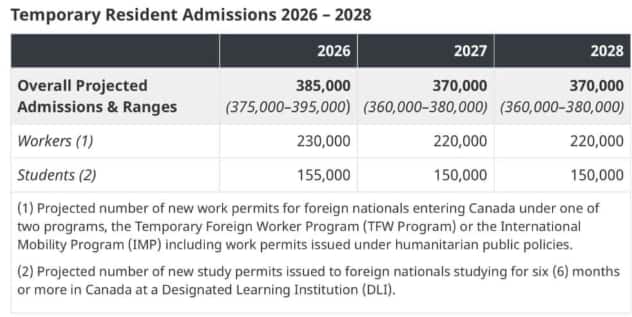
Source: Official, Government of Canada
Related Reads:
Why is Canada Budget Capping International Student Permits by 65% for 2026?
One of the best student cities in Canada, Ottawa, reports that rapid increases in temporary residents have strained communities. So, Canadian policymakers are tightening study-permit allocations while prioritising “top” research talent. That means undergraduate and many college-level intakes in Canada for 2026 and further years could face the largest squeezes. While some graduate students and top-tier researchers may see exemptions or different treatment. If you’re not in the exempted groups, your chances of getting a permit for the upcoming intake in Canada in 2026 could fall dramatically.
Impact of Canadian budget cuts on international students
Universities that rely on higher international tuition will likely feel budget stress, and that can change scholarship availability, program seats, and admissions timelines for international students. So, if you are planning to study in Canada in 2026, you might be impacted. Some institutions may prioritise applicants already in Canada, or those in research/graduate streams that are exempted, making overseas applicants face intense competition and tighter quotas. If you have an offer or admission letter, don’t assume it guarantees a permit anymore.
Will PSW Canada be Reduced With the Reduced Study Permits?
The cuts are part of a broader plan to reduce the total number of temporary residents (including workers and students) from 673,650 in 2025 to lower levels in subsequent years. With fewer study permits, downstream pathways to work and permanent residence may tighten, at least in the short term, so plan your career route accordingly.
Also Reads: Popular Medical Courses in Canada After 12th for Indian Students
Things To Do As International Students Applying To Study In Canada
With proposals including further capping of study permits in Canada for international students, you must take action to secure your visa and admission if you are planning for 2026. Here are some of the things to do as an international applicant:
Confirm your program’s status: Ask the chosen university in Canada if your program or level (graduate vs undergraduate) is likely to be exempt or prioritised. Don’t wait, and get written confirmation.
Apply earlier: If permits are limited, earlier applications and clear, high-quality documentation matter more than ever.
Explore graduate/research routes: Graduate students and research candidates may face fewer restrictions; consider options to study at master’s/PhD level or join a research project.
Consider alternative countries or deferred entry: if timing is critical, look at deferring, hybrid options, or other destinations with more open policies.
Stay updated: Government IRCC updates and your university’s international office will publish seat or cap details first.
Conclusion
Canada is planning to budget for 2026 with around 65% of the study permit cap on international students for the next years. This shows that the country is working to reduce immigration to Canada with such changes addressing the housing, health care crisis. So, an international student, you must consider all the aspects while choosing Canada for higher studies. Also, not all programs or applicants will be equally affected. If you’re strategic, such as targeting exempt/priority programs, offering a strong application, etc, you can still find routes to study in Canada in 2026.
Related Reads: Canada Student Visa Processing Time From India
Frequently Asked Questions (FAQs)
Q: Why is Canada rejecting student visas from India?
A:
Canada is rejecting student visas from India because the country has faced increased cases of fraud involving more than 1,550 fake study permit applications in 2023. These were linked to fraudulent study abroad agents from India.
Q: Is Canada accepting Indian students in 2025?
A:
Yes, Canada is accepting Indian students in 2025; however, they are faced with high scrutiny, requirements, and visa restrictions. Although Canada has imposed tougher immigration rules for international students, the country is still accepting applications from candidates with a stronger background.
Articles
Questions related to
On Question asked by student community
Have a question related to ?
Hello aspirant,
For admission to B. Tech and B. Arch programs, the Karnataka Examination Authority administers the Karnataka Common Entrance Test (KCET) each year.
The test is also known as K-CET, KEA UGCET, Kar CET, or Karnataka CET. Professional courses including B.Tech, B.E, B. Pharm, B.Arch, and BSc are offered
Hello Aspirant
Foreign Universities require a candidate to have a 4-year Bachelor's degree from a recognized University/college with enough credits. The problem that many Indian students face is that they have a degree in bachelor's but in a 3-year course. This stops them from pursuing further studies at a foreign
The eligibility criteria for MHCET (Maharashtra Common Entrance Test) can be based on domicile rather than place of birth.
MHCET often considers domicile, not necessarily the place of birth, for exam eligibility. Since your son has completed his entire school education in Maharashtra, this might strengthen his case for domicile
Hello aspirant,
Canada offers ample opportunities in the field of radiology. With a B.Sc in Radiology, you can explore various career paths in Canadian healthcare institutions, including hospitals, diagnostic imaging centers, and clinics. It's advisable to research the specific requirements and licensing procedures for radiology professionals in the province where
Dear aspirant !!
Hope you are doing good !!
Indian students must have an MBBS and clear USMLE tests to gain admission to post graduation after MBBS abroad in USA . It is important to understand that an MD/Doctor of Medicine (USA equivalent of MBBS in India) degree alone is

Applications for Admissions are open.
Admissions open for UG & PG programs at Illinois Tech Mumbai
University of Liverpool, Bengaluru Campus
ApplyStudy at a world-renowned UK university in India | Admissions open for UG & PG programs.
University of York, Mumbai
ApplyUG & PG Admissions open for CS/AI/Business/Economics & other programmes.
University of Bristol, Mumbai Enterprise Campus
ApplyBristol's expertise meets Mumbai's innovation. Admissions open for UG & PG programmes
Victoria University, Delhi NCR
ApplyApply for UG & PG programmes from Victoria University, Delhi NCR Campus